How to Use a Personal Loan to Consolidate High-Interest Credit Card Debt in Wisconsin
MW
Margaret Wack
Personal Finance Writer · Updated October 2026
Margaret Wack
Personal Finance Writer · Updated October 2026
Imagine a household in Madison facing a stack of credit card statements. Each month, they see interest charges eating up nearly 25% of their payments, making it feel like they are running on a treadmill that only goes faster. In 2026, this remains a common reality for many Wisconsin families struggling with revolving debt. A single $15,000 balance at a 24% APR can cost a borrower over $3,700 in interest alone in just the first year if they only make minimum payments. This is where personal loans often enter the conversation as a potential escape hatch.
The goal of debt consolidation via a personal loan is to replace multiple high-interest obligations with a single, lower-interest monthly payment. For many, this means moving from an APR that averages 22% on credit cards down to something much more manageable. In 2026, the landscape for lending remains dynamic; while rates fluctuate based on Federal Reserve decisions, the mathematical logic of consolidation stays consistent: if your new loan rate is lower than your average card rate, you could save significant money over the life of the debt.
This article isn't a sales pitch. Instead, it serves as an expert guide for Wisconsin residents looking to understand the mechanics, the math, and the potential pitfalls of this strategy. We will walk through real-world numbers, compare different approaches, and provide a framework for deciding if this move is right for your specific financial situation. Please note that all loan terms and approval outcomes depend on individual creditworthiness and specific lender requirements.
When deciding whether to consolidate, you must look beyond just the monthly payment. You need to compare the total cost of ownership for your debt. Credit cards offer extreme flexibility; you can pay as much or as little as you want each month. However, that flexibility is a double-edged sword that often leads to compounding interest cycles.
Personal loans, by contrast, are structured as installment loans. They have a fixed end date and a fixed monthly payment. This provides a predictable path to zero debt, which is something credit cards rarely offer unless you are extremely disciplined. Here is how they typically compare:
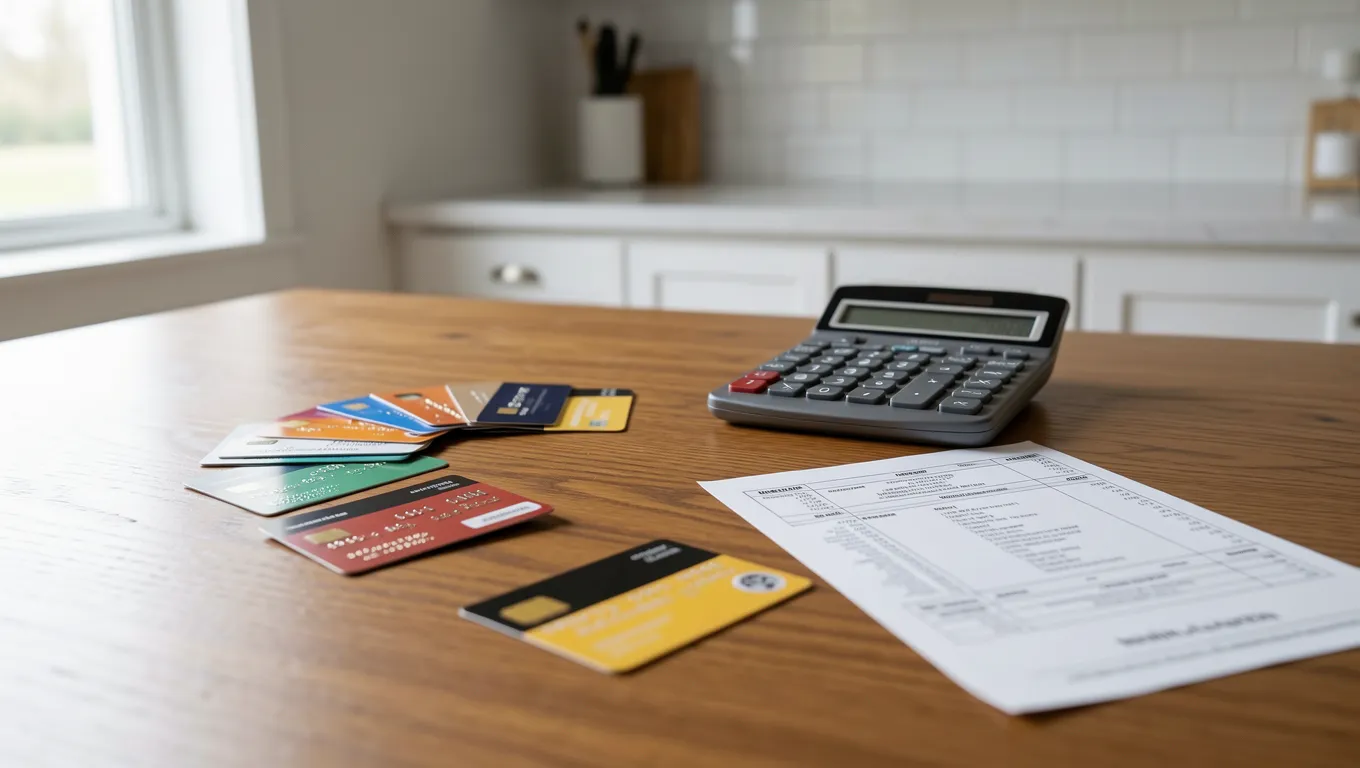
Person planning finances in a clean and bright workspace
To truly understand the impact, we need to look at how the math plays out in a real budget. Let's look at three different scenarios based on common debt levels seen in 2026.
Scenario A: The Small Balance Reset. If you have $5,000 in high-interest debt at 24% APR and you secure a personal loan at 11% APR for 36 months, your monthly payment would drop from a varying, high interest amount to approximately $161 per month. You would pay off the debt in exactly three years.
Scenario B: The Mid-Range Consolidation. Imagine a family with $12,000 in total credit card debt at 21% APR. By consolidating into a personal loan at 13% APR over 48 months, the monthly payment would be roughly $327. This provides a structured way to clear that $12,000 without the interest compounding against you every month.
Scenario C: The Significant Debt Overhaul. For a borrower with $25,000 in debt at 25% APR, moving to a personal loan at 12% APR for 60 months could result in a monthly payment of around $557. While the term is longer, the total interest paid over five years is drastically lower than staying on the credit card cycle.
Wisconsin residents have a unique advantage in the lending market: a robust network of both national digital lenders and local credit unions. When looking for consolidation options, your choice between these two can impact more than just your interest rate.
Local credit unions often provide a more personalized experience and may offer competitive rates for long-standing members. However, they might have stricter limits on how much you can borrow or require more documentation regarding your income in the state. National lenders often provide faster approval processes and digital-first experiences, which is convenient if you need to move quickly to avoid an upcoming interest rate hike.
Regardless of where you look, keep a close eye on these three factors:
Consolidation is not a magic wand; it is a tool that requires a plan to use correctly. If you simply move the debt and then continue spending on your old cards, you will end up in a much worse position than before.
Follow this framework to ensure a smooth transition:
It is easy to get caught up in the excitement of a lower monthly payment, but this is where many borrowers stumble. A common pitfall is the psychological effect of seeing zero balances on credit cards. This can create an illusion of wealth that leads to renewed spending.
Warning: Do not ignore the impact of origination fees and the total cost of debt over time. Many lenders charge an upfront fee, often between 1% and 8% of the loan amount, which is deducted from your proceeds. If you are consolidating $10,000 but pay a $500 origination fee, you only receive $9,500 toward your debt. You must factor this into your calculations to ensure the interest savings actually outweigh the cost of getting the loan.
Additionally, be wary of 'extending' the life of your debt. If you move a credit card balance that you could have paid off in 12 months into a personal loan with a 60-month term, you may end up paying more in total interest despite having a lower APR. Always look at the 'Total Interest Paid' figure rather than just the monthly payment.
Many Wisconsin borrowers worry that applying for a personal loan will tank their credit score. In reality, consolidation can actually be a powerful tool to improve your score if managed correctly.
When you consolidate, two major things happen to your credit profile. First, there is a 'hard inquiry' when you apply for the loan, which may cause a temporary, minor dip in your score. Second, and more importantly, your credit utilization ratio changes. By moving revolving debt (credit cards) into an installment loan, your credit card balances drop toward zero. Since credit utilization is a massive component of your FICO score, this can lead to a significant boost in your score over the next few months.
However, if you use that improved score to take on even more new debt, or if you fail to make the fixed payments on your new loan, the damage will be much harder to undo. The key is treating the consolidation as a permanent structural change to how you manage money, not just a temporary fix for a bad month.